Supplementing breast milk with formula may be an option that supports your feeding goals. While you can alternate between breast milk and formula, it’s also okay to mix breast milk with prepared formula.
See our article for more information on introducing formula to your breastfeeding baby.
What temperature should baby formula be?
Baby formula can be served cold, room temperature, or warmed.
If you do choose to warm your formula, it’s important to do it safely. See how to properly warm a bottle below.
Your baby will need different amounts of formula at different stages in their development. Babies also give certain cues to tell you when they’re full! To learn more about how much formula your baby needs, see our article on formula feeding.
Ready-to-feed formula is what it sounds like—ready to go when you need it! It’s a great option to make nighttime feeding or feeding while traveling more convenient.
There's no mixing required and only minimal prep work. Simply wash your hands, shake the ready-to-feed bottle before opening, and pour the formula into a clean baby bottle. Or, if you’re using a 2-fl-oz or 8-fl-oz ready-to-feed bottle, just twist on a nipple and ring. It’s that easy!
Note: If your baby doesn't finish a bottle of formula within 1 hour, throw it away.
How to store unopened ready-to-feed bottles
Store unopened ready-to-feed formula at room temperature; avoid extreme temperatures and protect from light. Store in original packaging until ready to use.
Storing ready-to-feed formula once opened
Storage of opened ready-to-feed formula will depend on which formula you are using.
- 32-fl-oz bottles: Immediately store re-capped, opened 32-fl-oz bottle in the refrigerator. Use the remainder of the formula within the timeframe listed on the label. If you pour the 32-fl-oz bottle into individual baby bottles, refrigerate them, and use within 48 hours.
- 2-fl-oz and 8-fl-oz nipple-ready bottles and 8-fl-oz cans: Cover and store immediately in the refrigerator. Feed within 48 hours, unless otherwise stated on the label or carton.
Do not reuse ready-to-feed bottles. Protect unopened 2-fl-oz bottles from light.
How to warm a bottle
Baby formula doesn’t need to be warmed, but if you prefer to warm it, do not microwave it. Microwaving baby formula can cause “hot spots” that can burn your baby. Instead, try one of the following methods.
Appropriate ways to warm formula
Water bath. Set the filled and capped bottle in a bowl of warm (not boiling) water. Make sure the top or neck of the bottle does not touch the water. Before feeding, swirl or shake the bottle to distribute warmed formula evenly, then sprinkle a few drops of formula on the inside of your wrist to make sure it’s not too hot.
Warm running water. Hold the capped bottle under warm running tap water. Make sure the top or neck of the bottle does not touch the water. Before feeding, swirl or shake the bottle to distribute warmed formula evenly, then sprinkle a few drops of formula on the inside of your wrist to make sure it’s not too hot.
Unfortunately, no. Once formula has been prepared and warmed, it’s best to serve it to your baby right away. Feeding reheated formula can negatively impact your little one’s health, as reheating can increase the potential for bacteria to breed and increase the risk of foodborne illness. Once feeding begins, use within 1 hour.
Have questions? Don’t keep them bottled up!
Find answers to some of your frequently asked questions below.
How much should I be feeding?
Your baby will need different amounts of formula at different stages in their development. Babies also give certain cues to tell you when they’re full! To learn more about how much formula your baby needs, see our article on formula feeding.
After opening a container of ready-to-feed formula, how long can it sit out?
If not being fed to your baby, formula should be immediately stored in the refrigerator until your baby’s next feeding. Helpful tip: Label prepared formula bottles with their expiration date and time.
Can I store Similac powder formula in a different container than the original can?
We recommend keeping Similac powder formulas in their original containers. Our packaging containers are specifically designed for infant formula. They are made to protect formula against oxygen and light, which can break down light-sensitive vitamins in our formula. Other containers would not have this protection.
Please note that each Similac container may have a different batch number and expiration date; this is another reason to keep powder in the original container.
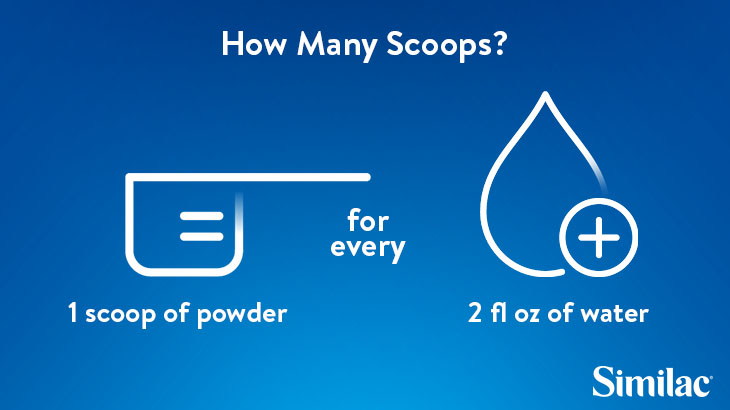
Yes, you can save yourself time by making multiple bottles of formula at once! If you are preparing a larger amount, just make sure to only prepare what your baby would drink in a 24-hour period. Then pour the prepared formula into individual feeding bottles, cap and store them immediately in the refrigerator, and use within 24 hours. To prepare a large batch of formula, follow the same formula-to-water ratio of 1 level scoop of powder (not packed down) for every 2 fl oz of water. For example, first measure 16 fl oz of water and then add 8 scoops of level, unpacked powder formula. To help prevent scoop counting errors during prep, make the next formula batch while baby is sleeping to give yourself a few minutes of uninterrupted time while you focus on formula prep.
How can I prevent my formula from getting clumpy?
Clumps can form in your formula if the water and powder don’t get thoroughly mixed. It is important to measure the water carefully and add it to the mixing container or bottle first, then add the powder.
My baby doesn’t seem to like the formula I’m giving them.
If your baby isn't responding well to the formula you’re using, consult your baby's pediatrician. It’s possible that it’s not the right formula for your baby.. Try our Formula Finder and our Tummy Trouble Tool for customized suggestions on how to help your little one feel better. It’s also possible that your baby isn’t liking the bottle or nipple you’re using. Take a look at our Similac bottles and nipples for new options.
How long does powder formula last once prepared?
Once mixed or refrigerated, baby formula must be used within 24 hours.
How far in advance can you mix baby formula?
You can make baby formula from powder up to 24 hours in advance. See the above instructions on how to prepare a batch of formula for more information.
Can you make baby formula with distilled water?
Yes, you can use distilled water to make formula. Tap water is normally safe, but if the water becomes unsafe in an emergency, such as a flood or a hurricane, you can use either distilled or purified bottled water. Most bottled water is not sterile. Ask your baby’s pediatrician for the safest option for your baby.
Can I make my own homemade baby formula?
We do not recommend using a homemade baby formula. Using homemade baby formula can lead to serious health problems for your baby. Your baby’s nutrition needs are very specific, especially in their first year of life, and homemade formulas may contain too little or too much of certain components, such as vitamins and minerals (like iron). They may also have an increased risk of contamination, which could make your baby sick.
How can I save money on Similac formula and get other feeding support?
To save money on formula and more, sign up to join MySimilacTM Rewards.
Have questions we didn’t cover? Consider getting live support from our Feeding Expert team by calling 800-986-8800 (8:30 AM – 7 PM ET) or talk to your baby’s healthcare provider for more information.