All about baby bottles and nipples
We’ll help you understand the many bottle shapes and nipple sizes
For some babies, finding the right baby bottle is more trial and error than choice. Your baby will decide what they like best. We’ll help you understand the many shapes and sizes, and you can help your little one choose by trying more than one style of baby bottle and nipple.
Browse bottles and nipples.
When selecting a baby bottle, explore shape, material, and size
You’ll find a wide array of bottles and nipples available in stores. Before you try one, or several, it helps to understand all your options. Check with your doctor if you need help finding the right one for your baby.
Baby bottle shapes: standard or curved
- Standard baby bottles (straight with no angle or curve) have been successfully used for years
- Curved baby bottles, and those with liners, are designed to reduce the swallowing of air and cut down on gas and fussiness
- Baby bottles with disposable liners are easy to clean, but the liner refills can be costly
Materials: plastic or glass baby bottles?
Glass baby bottles are sturdy but heavy and can shatter if dropped. Plastic baby bottles are lightweight and shatterproof, and many are BPA-free.
Baby bottle sizes: small for now, larger for later
Smaller bottles (4 fl oz or less) are nice when your baby is small. But as your baby grows, you’ll replace them with larger ones. Hint: When choosing a bigger bottle, make sure it will fit into your current diaper bag.
Baby bottle nipples: sizes, shapes, styles, and materials differ by design
Nipple shapes, sizes, and flow speeds need to match with your baby's sucking style and strength, so you may need to experiment. The size of the hole determines how quickly or slowly the milk flows. If the hole is the wrong size, your baby may feed too quickly, too slowly, or swallow too much air.
Bottle nipple sizes
These can vary by brand, so you may want to try different brands for just the right flow
- Size 1 nipples have a small hole, for newborn babies and those that don’t need faster flow—usually from birth to age 3 months
- Size 2, 3, and 4 nipples have progressively larger holes for faster flow and are great for older babies
The ideal bottle nipple allows a few drops of milk to drip out as soon as you turn the bottle upside down, then the dripping should stop. If you think the milk is flowing too quickly for your baby, try a nipple with a smaller hole. If you think your baby is getting frustrated by sucking too hard, try a nipple with a larger hole.
Baby bottle nipple shapes
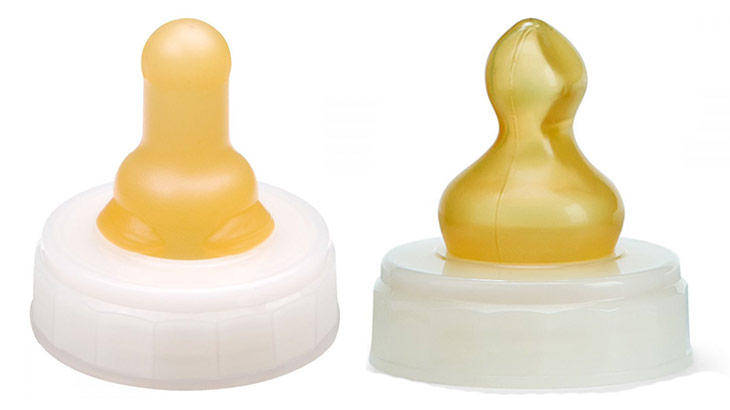
- Standard nipples are tall and dome-shaped, while other nipple types mimic the shape of your breast
- Orthodontic nipples are shaped to fit the inside of your baby's mouth—wide at the tip and base, and narrow in the middle
Baby bottle nipple materials
Latex
- Softer
- May wear out more quickly
Silicone
- Sturdier
- Can last up to a year