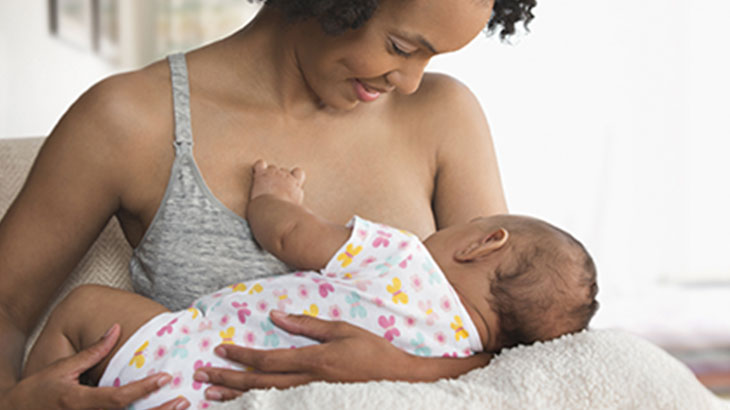
There is no "best" position for breastfeeding. But feeding is always easiest when both you and your baby are comfortable and relaxed.
Because every mom and baby are different, some positions may work better for you than others. Another reason to try different positions: It can help reduce breast tenderness, if your baby isn’t latching on and applying pressure to the same spot every time.
For seated breastfeeding positions, find a comfortable chair that supports your arms and back. Add pillows or rolled blankets to help support your body and bring baby up to the level of your breast. Using a footstool under your feet may also help to relieve back strain and support you better during breastfeeding. Try not to hunch your shoulders.
Nursing position #1: the cross-cradle hold
This is a good position for new breastfeeding moms and babies, for moms with premature babies, and for those who have trouble getting their little one to latch on. This position makes it easier to see your baby latch on compared to the traditional cradle hold.
For this hold, your baby will be in the same position as in the cradle hold (see below), but you will use the arm opposite the breast from which they are feeding to cradle their back. With that hand, gently support the base of your baby’s head. The hand that’s on the same side of the breast from which your baby is feeding will be used to support the breast, either in a C-hold or U-hold. Your baby should be level with your breast, with their body turned toward you. Some mothers find they can tuck baby's bottom into the crook of their arm. When your baby opens their mouth wide, pull them onto the breast far enough that the tip of their nose, their cheeks, and their chin are all touching your breast.
Nursing position #2: the cradle hold
Support your breast with your hand in a cupped C-shape. Place your baby across your stomach, tummy to tummy.
Your baby's head should be in the bend of your elbow, and their mouth should be directly in front of your nipple. Use a pillow to support your arm. Tuck their lower arm around your waist, out of the way.
If correctly positioned, your baby's body should form a straight line from their ear to shoulder to hip.